
Intelligent security, professionally designed Free AI CCTV site survey
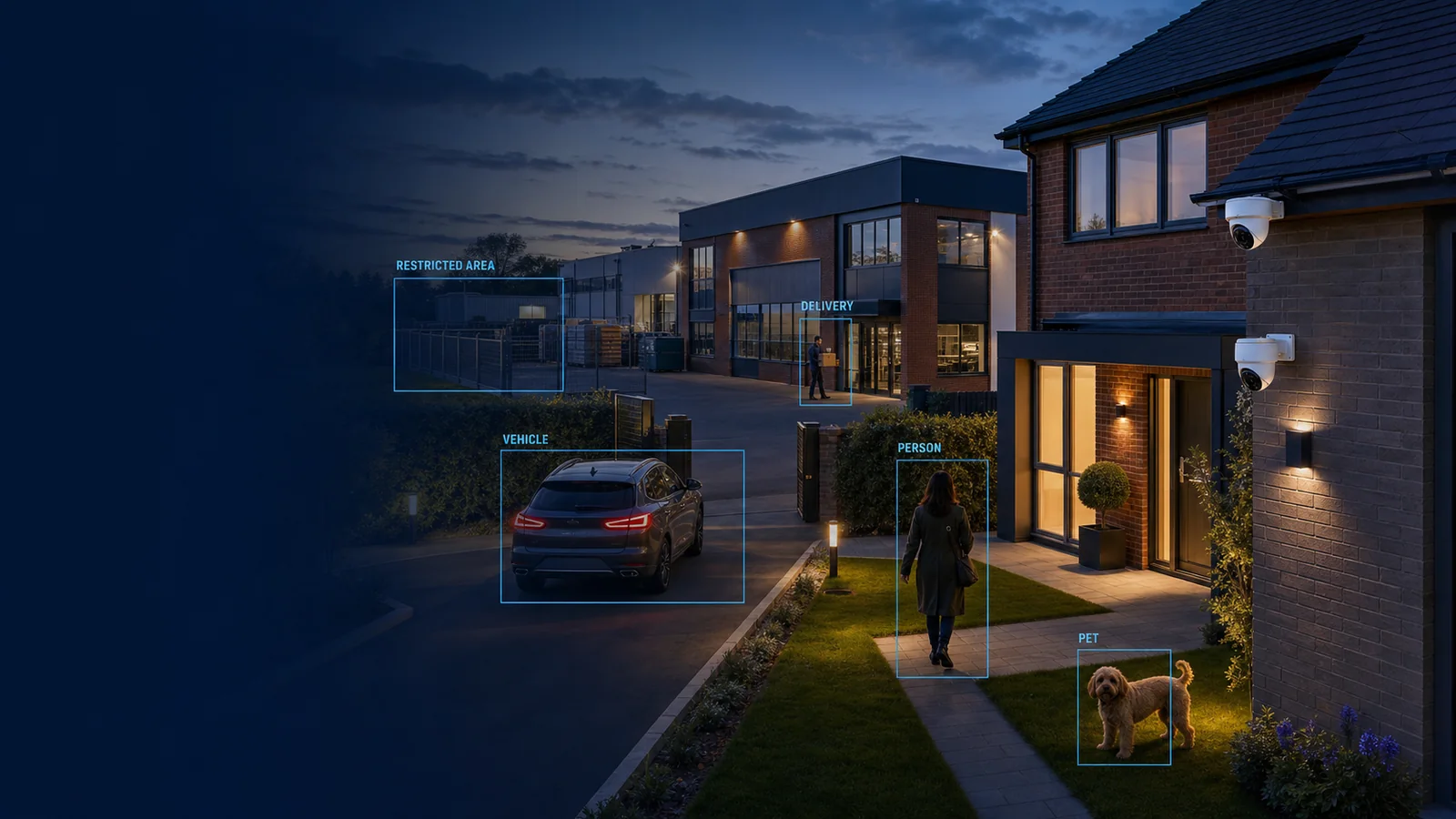
Modern UK home and business protected by AI CCTV identifying a person, vehicle, pet, delivery and restricted area
AI security cameras for homes and businesses

Smarter CCTV. Fewer false alarms. Better protection.

BlueMax designs intelligent CCTV around the events that matter—using human detection, vehicle detection and carefully configured analytics to turn hours of video into useful alerts and searchable evidence.

  • Human and vehicle classification
  • Intelligent event search
  • Professional design and support

Relevant alertsClassification configured around genuine risks

Faster reviewFind people and vehicles without scrubbing hours

Useful at nightImaging and analytics planned for real lighting

Human supportSurvey, configuration, training and aftercare

Why intelligent CCTV matters

The value is not more notifications. It is better information.

Conventional motion recording can react to almost anything that changes pixels. AI CCTV adds classification and rules so a system can prioritise a person crossing a boundary, a vehicle entering a drive or an object left in a controlled area—while still recording the wider scene.

Focus on real events

Human and vehicle classification can reduce interruptions caused by ordinary background movement.
More useful alerts

Zones, schedules and event rules help notifications match how a property is actually used.

Faster investigations

Filtered playback can surface classified events instead of forcing users to review continuous video.

Proportionate coverage

A clear purpose for every view supports privacy, evidence quality and sensible retention.

Site-specific intelligence

Analytics are selected and tuned for angle, distance, lighting, traffic and genuine threat routes.

Supported operation

BlueMax trains authorised users and refines the configuration as seasons or site use change.

The practical guide to intelligent video

What is AI CCTV—and what does it actually do?

AI CCTV uses computer vision to analyse video, distinguish selected object types and apply rules to their movement. It does not make a camera all-knowing, and it does not replace good positioning. It gives a correctly designed system a more useful way to organise events.

From pixel change to object classification

Traditional video motion detection asks a relatively simple question: did enough of the image change? When neighbouring pixels change beyond a threshold, the recorder can mark an event or send an alert. That approach is inexpensive and useful for creating playback markers, but it cannot reliably explain whether the change was a person, a delivery van, swaying foliage or a sudden patch of sunlight. A sensitive setting captures too much; a less sensitive setting may miss the movement the owner cares about.

AI CCTV adds a trained classification model. Computer vision converts image information into features that software can compare with patterns learned from large datasets. Deep learning models can then assign a likely class such as human or vehicle and track that object across consecutive frames. Machine vision is the wider idea of a system interpreting visual information; object classification is the narrower task of deciding what kind of object appears to be present. In security cameras, these techniques support event filters, boundary rules, search and notifications.

The result remains a probability, not certainty. A distant figure, heavy rain, glare, occlusion, unusual clothing or a poorly placed camera can lower confidence. BlueMax therefore designs for suitable subject size, angle, light and scene stability before adjusting sensitivity or confidence settings. The AI should support evidence—not compensate for a view that cannot see the event clearly.

Edge AI, recorder AI and the processing path

Analytics may run at the edge inside the camera, at a network video recorder, or across both devices. Edge processing can classify an event close to where video is captured, reducing unnecessary traffic and attaching useful metadata before footage reaches the recorder. Recorder-based analytics can add intelligence to compatible streams and provide a central place for search and configuration. Exact capabilities depend on the camera, recorder, firmware, resolution, channel allocation and licensing; a feature name on one model does not guarantee identical behaviour on another.

A typical event passes through several stages. The sensor captures frames; the image processor prepares the picture; an inference model looks for objects; tracking follows their position; a rule tests whether the object entered a zone or crossed a line; then the system records, tags, displays or notifies according to configuration. Network availability may affect a mobile push notification, but a properly designed local camera-and-recorder system can continue recording when the internet connection is unavailable.

That chain explains why installation quality matters. Shutter speed, compression, frame rate, mounting height, backlight, vegetation and the number of pixels across a subject can all influence classification. The correct response to poor alerts is not automatically a more expensive camera. It may be a tighter angle, a different mounting position, better scene lighting, a revised detection zone or a schedule that reflects opening hours.

Why ordinary motion detection creates false alarms

Outdoor scenes constantly change. Trees and shrubs move in the wind; rain and snow streak across infrared light; shadows stretch as clouds pass; cats, birds and foxes cross a garden; headlights sweep over a wall; insects and cobwebs sit very close to the lens; reflections move in glass; and automatic exposure changes when a doorway opens. Each event can alter enough pixels to satisfy a conventional motion rule even though no security threat exists.

Repeated nuisance notifications create a behavioural problem as well as a technical one. When a phone alerts for every branch or moth, people mute the application or stop checking. The system may record perfectly, but its warning function loses credibility. AI human detection and vehicle detection can filter many of these events by asking whether the moving region resembles a selected class. This can substantially reduce false alarms, but it cannot promise zero false alerts in every scene.

Good configuration combines classification with geometry and time. A line-crossing rule can ignore pedestrians who remain on the public pavement but react when a human crosses onto a drive. A vehicle zone can cover an entrance without alerting for traffic beyond the boundary. Schedules can apply a stricter rule when a shop is closed. Minimum and maximum object sizes can reject movement too small or too large to be relevant. BlueMax tests the chosen rule by walking the real routes and reviewing night behaviour rather than relying on a factory default.

Human detection and vehicle detection

Human detection looks for body-like visual patterns, while vehicle detection looks for cars, vans and other supported vehicle shapes. These categories are useful because they align with common security questions: did somebody approach the rear door, or did a vehicle enter the yard after hours? They can tag recordings, trigger a push alert, activate a compatible output or help an authorised user filter playback.

Classification works best when the target is large enough in the frame and moves through a clear field of view. A camera facing directly down from a high roofline may show the top of a head but provide weak identification and less reliable classification. A vehicle behind a hedge or a person partly hidden by a pillar may only appear briefly. Surveying the route first allows camera height, lens and detection boundary to work together.

Perimeter protection, line crossing and intrusion detection

Perimeter protection is an outcome rather than one button. Line crossing detects a classified object moving across a virtual line, often with a chosen direction. Intrusion detection looks for an object entering or remaining within a polygonal zone. These rules can protect a gate, fence line, stock compound, side passage or loading area more precisely than full-frame motion. Direction matters: a business may want an alert when somebody enters a staff-only area but not every time they leave.

Zones should be placed where the camera can observe a complete crossing, not on the very edge of the image or behind a likely obstruction. Perspective also matters because a person farther away occupies fewer pixels. A professional setup tests ordinary authorised movement, delivery routines, public paths and likely intrusion routes before deciding what should alert, merely record or be excluded.

Facial recognition, face capture and responsible use

Face capture, facial comparison and facial recognition are different capabilities. A camera may capture a face-quality image or allow a user to find footage containing faces without identifying the individual. Facial recognition compares a facial template against a reference database to infer identity. Where that processing uniquely identifies a person, it normally involves biometric data and may involve special-category data under UK data-protection law.

BlueMax does not describe every AI camera as facial recognition. Where a customer has a genuine requirement, availability, accuracy, lawful basis, transparency, access controls, retention and proportionality must be considered. Organisations may require a data-protection impact assessment and appropriate human review. For many homes and smaller businesses, human classification provides the intended security outcome without identifying who the person is.

Object left behind, object removal, crowd and queue analytics

Some compatible systems can detect an item left within a defined area or an expected object being removed. These rules can support luggage areas, displays, tools, stock zones or emergency routes, but they depend heavily on a stable view and a clear definition of the object and time threshold. Shadows, temporary occlusion and routine rearrangement can complicate results, so they should be trialled against the operational scene.

Crowd-density and queue analytics estimate occupancy or waiting conditions inside a selected region. Retailers, reception areas and venues may use this information to prompt staff response or understand flow. It is not automatically a precise people-counting system, and accuracy can fall when people overlap, the camera angle is shallow or the entrance is too wide. Requirements should state whether the goal is an operational prompt, a trend or a formally audited count.

AI CCTV for homes

At home, intelligent CCTV is most useful when it fits ordinary routines. Human detection can highlight an approach to a door, side gate or rear garden. Vehicle detection can tag arrivals on a driveway. A delivery zone can help locate parcel activity, and a holiday schedule can make an alert more sensitive while the property is unoccupied. Families can check whether children have arrived or whether somebody entered a garden without receiving a notification for every moving branch.

Pet classification is available on some platforms, but camera model, distance and species affect performance. A small pet at the edge of a dark garden may still be difficult to distinguish, and human-or-vehicle filtering may intentionally ignore it. BlueMax agrees whether animals should generate, suppress or merely remain visible within events. The purpose is a calm, useful system—not a stream of automated guesses.

Privacy remains part of good design. Detection zones should focus on the customer’s entrances and land; privacy masks can obscure neighbouring windows or gardens; audio should be enabled only where necessary and responsible; and retention should match the purpose. Read the complete home CCTV installation guide for property types, camera positions and homeowner responsibilities.

AI CCTV for businesses

Business sites need rules that match operations. A retail shop may prioritise entrances, tills and stock-removal context. A warehouse may use human or vehicle classification at yard gates, line crossing around high-value cages and event search after a delivery discrepancy. Offices may focus on out-of-hours entrances; schools on perimeter routes and safeguarding governance; hotels on public approaches; restaurants on rear delivery doors; farms on remote buildings and machinery; construction sites on temporary boundaries; and industrial premises on yards, loading areas and restricted zones.

Analytics should not be treated as automatic management or a substitute for staffing, access control, lighting, barriers or an alarm. The response plan matters: who receives an alert, when, how they verify it and what they are authorised to do. Notifications that nobody reviews add little value. BlueMax therefore maps the event, camera view, recording, recipient and escalation route as one operational workflow.

Businesses also require governance. Access should be role-based; searches and exports should be controlled; signage and privacy information should explain the processing; retention should be justified; and staff monitoring must be lawful, fair and transparent. Explore the commercial CCTV installation guide for sector planning, system sizes and business-focused FAQs.

ColorVu and AI: two different technologies that work well together

AI analytics decides what an event may contain. ColorVu addresses how a scene is imaged in low light. Suitable ColorVu cameras use sensitive sensors, wide apertures and image processing to retain colour in conditions where a conventional infrared camera may switch to monochrome. Colour can help distinguish clothing, vehicles or objects and can make reviewed footage easier to understand.

ColorVu is not magic daylight in total darkness. Performance depends on ambient illumination, subject movement, lens, distance and exposure. In extremely dark scenes, compatible cameras may use supplemental white or hybrid lighting. A fast-moving subject can still blur if the exposure is too long. BlueMax assesses real night conditions, nearby lighting and the effect on neighbours before selecting full-colour, infrared or hybrid imaging.

Combining a clear night image with human and vehicle classification can improve the information attached to an event, but the fundamentals remain the same: the target must be visible, appropriately sized and not overwhelmed by glare. Lighting and angle are part of the AI design, not extras considered after installation.

Five common myths about AI security cameras

“AI CCTV recognises everyone.” Most systems discussed on this page classify object types; they do not identify an individual. Facial recognition is a distinct capability with additional technical and legal implications. “AI means no false alarms.” Classification can reduce nuisance events, not eliminate every error. Weather, distance, obstruction and scene design still matter.

“The highest resolution has the best AI.” Resolution helps only when lens, subject size, light, compression and processing support the task. A well-positioned 4MP camera can be more useful than a badly placed higher-resolution unit. “Every feature works on every camera.” Analytics vary by product range, recorder, firmware and channel. Written specifications must confirm the chosen functions.

“AI replaces professional monitoring or human judgement.” It provides a filter and prompt. A person should verify important events, and critical sites need a documented response plan. Security decisions should never rely on a label alone when the underlying footage is unclear.

Accuracy, privacy and a dependable operating model

Accuracy is not a single permanent percentage. It changes with weather, season, camera cleanliness, lighting, target distance, crowding and the chosen rule. A site may perform well in summer until leaves obscure a route, or at dusk until headlights flare across the detection zone. Periodic review should confirm time, recording health, alert frequency, camera view, night exposure and authorised users. Firmware updates and configuration changes should be controlled and documented.

A proportionate system begins with purpose. Define the incident to deter or investigate, identify the least intrusive view that can provide useful evidence, limit users, secure the recorder, protect account credentials and retain footage only as long as needed. Where cameras capture public or neighbouring space, signage and privacy information may be required. Organisations should record their lawful basis and respond properly to access requests.

Cybersecurity also matters. BlueMax changes default credentials, configures authorised accounts, explains secure remote access and avoids unnecessary exposure of recorder services. Customers should maintain supported devices, protect phones, remove former users promptly and never share a single administrator login across a large team. AI metadata is useful only when the underlying system remains secure and trustworthy.

An intelligent event is not automatically an alarm response

It is important to separate detection, verification and response. A camera may classify a human inside a zone and create an intelligent event. The recorder may then preserve footage and send a notification. An authorised person still needs to examine the image, decide whether the activity is expected and follow an agreed action. A label does not establish criminal intent, and an unverified mobile alert should not be treated as proof.

For a household, the response may be as simple as checking live view before answering the door or calling a trusted neighbour while away. A business may need a documented escalation path that distinguishes staff, contractors, deliveries and out-of-hours visitors. Higher-risk sites can integrate selected outputs with a compatible alarm, lighting or monitoring workflow, but that integration must be designed, tested and maintained as a complete system. Camera analytics alone are not a substitute for a certified intruder alarm where one is required by an insurer or risk assessment.

Notification design should also respect people’s attention. Sending the same event to every employee creates confusion and weakens accountability. BlueMax agrees recipients, schedules and rules, then demonstrates how to pause, acknowledge or investigate an event where the platform supports it. The objective is a small number of actionable prompts backed by clear video—not an impressive number of alerts.

Build AI CCTV as one layer of security

Intelligent cameras are strongest when the property already manages delay, visibility and access. Gates and locks slow an approach; lighting improves both deterrence and image quality; trimmed vegetation keeps views clear; access control records authorised entry; an intruder alarm detects breaches; and CCTV explains what happened. No one layer should carry the whole security plan.

This layered approach prevents technology from being specified for the wrong problem. If a vehicle can enter an open yard freely, a barrier may reduce risk more directly than another camera. If a dark entrance produces blurred faces, lighting or a tighter identification view may matter more than adding analytics. If valuable stock is left outside every night, the operating procedure needs attention alongside the perimeter alert. BlueMax uses the survey to identify these dependencies and states where CCTV supports rather than solves the risk.

Resilience should be considered too. Local recording keeps evidence on site; an uninterruptible power supply may help selected equipment ride through brief outages; secure recorder placement reduces tampering; and appropriate network design separates business-critical devices. Remote or exposed locations may need protected cabinets, surge considerations or a secondary communications path. These are engineering choices based on consequence, not automatic additions to every quotation.

Ownership, training and evidence export

A sophisticated system fails if nobody knows how to use it. The handover should show authorised users how to view live video, search classified events, review the surrounding timeline, export a clip, preserve the original time and understand the difference between a notification and continuous footage. It should also explain which administrator controls can alter recording, analytics or privacy settings.

Evidence exports need context. A short event clip may omit the approach or aftermath, while a phone recording of a monitor can lose quality and metadata. Where an incident matters, users should export the relevant period through the recorder or supported application, keep an original copy, document who handled it and provide it securely to an insurer, police officer or authorised investigator. Businesses may need a formal evidence-release procedure and audit trail.

BlueMax supplies practical training around the installed platform and remains available for support. The customer remains responsible for managing users, responding to lawful requests, maintaining their wider network and operating the system for the stated purpose. Staff changes, new tenants, landscaping, building work and revised opening hours are all reasons to review access and rules. A short, controlled review is safer than allowing years of undocumented changes to accumulate.

How to specify an AI CCTV system

Start with outcomes rather than feature names. Write down which routes, objects and times matter; whether the system must notify, tag, search or activate another device; who will respond; and what evidence quality is needed. A free BlueMax survey then checks camera geometry, lighting, network, power, cable routes, recorder location, storage target, privacy boundaries and expansion capacity.

The quotation should name the camera and recorder models, resolutions, lenses, proposed analytics, storage assumption, installation scope, mobile access, training, warranty and exclusions. Where a specialist feature such as queue analysis, ANPR or facial comparison is proposed, its conditions and limitations should be explicit. A demonstration or trial may be appropriate for business-critical analytics.

After installation, commissioning is as important as mounting. BlueMax focuses each view, draws detection zones, tests real crossings, checks day and night playback, sets schedules, creates authorised users, confirms alert delivery and explains export. The handover records the agreed configuration so future refinements are deliberate rather than guesswork. This is how intelligent CCTV becomes a reliable security tool instead of a long list of unused menu options.

Not sure which analytics suit your property?BlueMax will translate your risks into a practical camera and detection plan.
Book free AI security survey
Intelligent CCTV capabilities

Ten AI features, selected for the job—not added as a checklist.

Availability and performance vary by product, scene and configuration. BlueMax confirms the required feature in the written system design.

Human detection

Classifies person-like targets for alerts, playback tags and defined security rules.

Vehicle detection

Identifies supported vehicle classes at driveways, entrances, yards and loading areas.

Smart alerts

Combines class, zone, direction and schedule to make mobile notifications more relevant.

Perimeter protection

Applies intelligent rules to gates, fences, boundaries and controlled external routes.

Line crossing

Triggers when a selected object crosses a virtual line in an allowed direction.

Intrusion detection

Identifies a target entering or dwelling within a precisely drawn area.

Smart search

Filters recorded events by classification to accelerate investigations and exports.

Object analytics

Supports left-behind or removed-object rules on compatible systems and stable scenes.

Crowd and queue analysis

Provides operational prompts or trends where angle, density and objective are suitable.

ColorVu

Retains colour in suitable low-light conditions to add context to intelligent events.

Normal CCTV vs AI CCTV

Both record video. AI changes how events are filtered and found.

The right choice depends on the site and outcome. AI is most valuable when conventional motion creates noise or event review consumes time.

CapabilityNormal CCTVAI CCTV
Continuous recording Available Available
Basic pixel motion Standard With intelligent filters
Human and vehicle classes Usually unavailable On supported equipment
Nuisance alert reduction Sensitivity and zones Classification plus rules
Event search Timeline review Filtered by supported classes
Line and intrusion rules Limited or basic Class-aware on compatible models
Professional design needed Yes Essential for reliable analytics
Who should consider AI CCTV?

Sites where relevance, response time and searchable evidence matter.

An intelligent system is especially useful where ordinary movement is frequent but only particular people, vehicles or boundary events require attention.

Homes and driveways

Separate callers and vehicles from foliage, pets and public-road movement around a property.

Retail and hospitality

Review entrances, stock areas, queues and out-of-hours movement with controlled access.

Warehouses and yards

Protect gates, compounds, loading routes, plant, cages and controlled operational zones.

Offices and education

Prioritise after-hours entrances and perimeter events under clear governance.

Farms and rural sites

Filter movement around remote buildings, machinery, fuel, gates and long approaches.

Construction and industry

Support temporary boundaries, restricted areas and investigation of vehicle activity.

Example AI CCTV applications

Five practical designs shaped around different security questions.

These illustrative examples show how BlueMax approaches outcomes. Final equipment, analytics and results depend on a survey and written specification.

01

Family home driveway

Need: useful alerts without notifications from a tree and passing traffic.

Approach: a tighter driveway view, vehicle zone and human line crossing inside the boundary, with road activity excluded.

Outcome: fewer nuisance prompts and faster review of callers and arrivals.

02

Cambridge retail shop

Need: quick review of entrances and rear-door movement after closing.

Approach: human classification, an out-of-hours schedule and role-controlled playback.

Outcome: relevant event markers without continuous manual timeline searching.

03

Warehouse yard

Need: distinguish people and vehicles entering a controlled loading area.

Approach: separate directional line rules, overview recording and focused gate coverage.

Outcome: clearer incident chronology and a response prompt matched to operating hours.

04

Rural workshop

Need: protect a remote building where wildlife and weather caused constant motion events.

Approach: human and vehicle filters, stable mounting, refined zones and night-light assessment.

Outcome: a more credible alert channel while continuous local recording remains available.

05

Office reception

Need: understand queue pressure without using identity recognition.

Approach: a suitable overhead view and supported queue-duration analytics with a clear operational threshold.

Outcome: a staffing prompt based on flow rather than biometric identification.

The BlueMax process

Eight steps from security question to a tested intelligent system.

Professional AI CCTV begins with purpose and ends with evidence, training and ongoing support.

  1. 01

    Discovery call

    We identify the events, times, locations and response outcomes that matter.

  2. 02

    Free site survey

    We inspect routes, subject distance, light, obstructions, network, power and privacy boundaries.

  3. 03

    Risk and privacy design

    Every proposed view and analytic receives a clear, proportionate purpose.

  4. 04

    Written specification

    Models, lenses, analytics, storage, access and exclusions are documented.

  5. 05

    Professional installation

    Cameras, containment, recorder and network are installed neatly and securely.

  6. 06

    AI commissioning

    Zones, lines, classes, sizes, schedules and notification rules are configured.

  7. 07

    Real-world testing

    We test day and night crossings, playback, alerts, users and evidence export.

  8. 08

    Training and aftercare

    Authorised users receive a clear handover, warranty and direct BlueMax support.

AI CCTV questions

Detailed answers before you choose an intelligent CCTV system.

These answers explain capabilities and limitations. A BlueMax survey confirms what will work at your property.

What is AI CCTV?

AI CCTV uses computer-vision models to analyse video and classify supported objects or behaviours. It can tag a person or vehicle, apply a virtual line or zone rule, filter playback and trigger a configured alert. It remains dependent on a clear image, compatible hardware and careful setup.

How is AI CCTV different from motion detection?

Basic motion detection reacts when enough pixels change. AI classification adds an estimate of what caused that change. This can reduce alerts from rain, foliage or shadows when the rule is set to react to a person or vehicle, although no system eliminates every error.

Does AI CCTV record continuously?

It can. A compatible NVR may record continuously while AI metadata marks important events, or it can use event schedules subject to the security objective and storage plan. Continuous recording provides context before and after an alert and does not rely on the AI recognising every event.

Can AI CCTV distinguish people from animals?

Human classification can reject many animals, and some products offer pet categories. Results depend on the species, size, distance, angle and lighting. A small animal close to a lens or a partly hidden person can still be misclassified, so BlueMax tests the actual scene.

Can AI CCTV identify an individual person?

Most person-detection systems classify a human shape without identifying who it is. Facial recognition is a separate biometric process that compares a template with a reference database and brings additional legal, accuracy and governance responsibilities.

Is facial recognition legal in the UK?

There is no simple universal answer. An organisation needs an appropriate lawful basis, and uniquely identifying a person normally involves biometric and potentially special-category data. Necessity, proportionality, transparency, security, accuracy and a data-protection impact assessment may need consideration. Obtain specialist advice for the proposed use.

What is human detection?

Human detection is an object-classification feature that estimates whether a target resembles a person. It can be combined with zones, line crossing, schedules, recordings and notifications. It does not confirm identity or intent.

What is vehicle detection?

Vehicle detection estimates whether an object belongs to a supported vehicle class. It is useful for driveway, gate, yard and loading-area events. It is not automatically number-plate recognition, and performance depends on an unobstructed, suitably sized view.

Will AI CCTV stop all false alarms?

No. It can substantially reduce nuisance alerts caused by common scene movement, but glare, obstruction, weather, unusual targets, lens contamination and poor positioning can still create errors. A dependable installation combines classification, good geometry, schedules and periodic review.

What causes false CCTV motion alerts?

Common causes include trees, rain, snow, shadows, cats, birds, headlights, insects, cobwebs, reflections and rapid exposure changes. Basic motion sees image change; it does not understand the reason for the change.

Does AI processing happen in the camera?

It may happen in the camera, in the NVR or across both. Edge AI can classify events before transmission, while recorder analytics provide central processing and search. Compatibility, channel limits, firmware and feature allocation must be checked for the proposed combination.

Will AI CCTV work if the internet goes down?

A properly configured local camera-and-NVR system can continue recording without an internet connection. Mobile viewing, cloud services and push notifications may be unavailable until connectivity returns. The survey confirms which functions are local and which depend on external services.

What is line-crossing detection?

It detects a supported object crossing a virtual line, optionally in one direction. It can protect a gate or boundary more precisely than full-frame motion, provided the line is positioned where the camera sees the complete crossing.

What is intrusion detection?

Intrusion detection uses a drawn zone and triggers when a supported target enters or remains within it according to configured rules. Despite the name, it cannot know a person’s intention; the zone and response must be designed around a real security purpose.

What is perimeter protection?

Perimeter protection combines camera placement, human or vehicle classification and rules such as line crossing or intrusion around fences, gates and controlled routes. It should complement physical security, lighting and a response process rather than replace them.

Can AI CCTV detect an object left behind?

Some compatible systems can flag an item that remains in a region beyond a chosen time. A stable view, consistent lighting and a clear operational definition are important. Busy scenes, occlusion or routine movement of objects can reduce reliability.

Can AI CCTV detect a removed object?

Supported object-removal analytics can monitor whether an expected item disappears from a defined area. They are scene-dependent and should be tested for the specific display, tool, stock location or protected asset rather than assumed from a feature label.

Can AI CCTV analyse queues or crowds?

Compatible analytics can estimate queue duration, occupancy or density within a region. Accuracy varies with angle, overlap and site layout. Decide whether the requirement is a prompt, a trend or a formally verified count before choosing equipment.

What is smart search?

Smart search uses recorded metadata to filter events by supported classifications or rules. It can reduce investigation time, but the underlying footage should still be reviewed to verify the event before a decision or evidence export.

What is ColorVu?

ColorVu is a low-light imaging technology designed to retain colour in suitable dark scenes through sensitive sensors, wide apertures and image processing. Extremely dark locations may need supplemental light. It is separate from AI classification but can add useful visual detail.

Does ColorVu work in complete darkness?

Not without some light. In extremely dark conditions, compatible cameras may use white or hybrid supplemental illumination. Results depend on distance, movement, exposure and the scene, so BlueMax assesses night conditions rather than promising daylight-quality colour everywhere.

Is a higher-resolution camera always better for AI?

No. Resolution is only one factor. Lens choice, target size, angle, lighting, shutter, compression and the AI model all affect results. A correctly positioned camera with an appropriate view can outperform a higher-resolution camera mounted too far away.

Can AI CCTV send mobile alerts?

Yes, compatible systems can send notifications for configured events. BlueMax limits recipients, zones and schedules so alerts remain useful. Mobile notifications normally require internet access and a supported application account.

Can AI CCTV protect a home driveway?

Yes. A driveway design can classify people and vehicles, exclude passing traffic and focus on movement within the property. The camera still needs a suitable angle for evidence, and public or neighbouring space should be minimised.

Is AI CCTV suitable for a small business?

Yes when there is a clear outcome such as out-of-hours entrance alerts, faster event search or fewer yard notifications. A small site does not need every analytic. BlueMax selects the minimum practical system around the business risk and response plan.

Can AI CCTV monitor employees?

Workplace monitoring must be lawful, fair, necessary, proportionate and transparent. Employers should define the purpose, consider less intrusive options, inform workers, control access and avoid using security CCTV for incompatible performance monitoring without proper assessment and advice.

How much storage does AI CCTV need?

Storage depends mainly on camera count, resolution, frame rate, compression, recording schedule and desired retention. AI metadata itself does not remove the need for storage planning. BlueMax calculates an assumption and confirms it in the quotation.

How accurate is AI CCTV?

There is no honest single percentage for every installation. Accuracy changes with the model, scene, target size, lighting, weather and configuration. Important analytics should be commissioned with real-world tests and reviewed after seasonal or operational changes.

Does every AI camera support the same features?

No. Human and vehicle classification, face capture, queue analytics, object rules and search functions vary across cameras, recorders, firmware and licences. BlueMax names the equipment and confirmed functions in the written specification.

How often should AI CCTV be maintained?

Check recording, time, views, lenses, alerts, users and night images regularly, and after landscaping, building work or lighting changes. Business-critical systems may need a formal maintenance schedule. Configuration should be refined when legitimate site movement changes.

Can I add AI cameras to an existing CCTV system?

Possibly. Compatibility depends on the recorder, protocol, firmware, channels, resolution and where the analytics run. BlueMax can audit the existing system and explain whether cameras, recorder or both need upgrading.

How does BlueMax protect AI CCTV from cyber risks?

BlueMax changes default credentials, configures authorised users, explains secure remote access and avoids unnecessary service exposure. Customers should keep supported firmware, protect mobile devices, remove former users and use individual strong credentials.

Do you install AI CCTV in Cambridge?

Yes. BlueMax is headquartered in Cambridge and installs intelligent home and commercial systems across Cambridgeshire and throughout the UK. See the CCTV installation Cambridge guide for local service information.

What happens during a free AI security survey?

BlueMax reviews threats, routes, lighting, distances, network, power, cable paths, privacy boundaries, storage, users and response expectations. You receive a written system design and quotation describing the proposed analytics and their conditions.

What warranty does BlueMax provide?

Qualifying equipment supplied by BlueMax and BlueMax workmanship are covered by the three-year on-site replacement warranty, subject to the published terms and exclusions. Read the full warranty before booking.

Why choose BlueMax

Intelligent technology, grounded in professional security design.

BlueMax Technology Support Ltd combines site-specific advice, genuine compatible equipment, neat workmanship, responsible configuration and long-term support. We explain what an analytic can do, where its limitations lie and how your team or household should use it.

3 yearsOn-site replacement warranty, subject to terms
FreeAI security survey and written quotation
12902082Registered in England and Wales
Mon–Sat8:00am–6:00pm business hours
Free AI security survey

Turn the events that matter into a smarter CCTV plan.

Speak to BlueMax for a site assessment, intelligent camera design, transparent quotation and professional installation.

CallBook AI survey
WhatsApp