
Focus on real events
Human and vehicle classification can reduce interruptions caused by ordinary background movement.
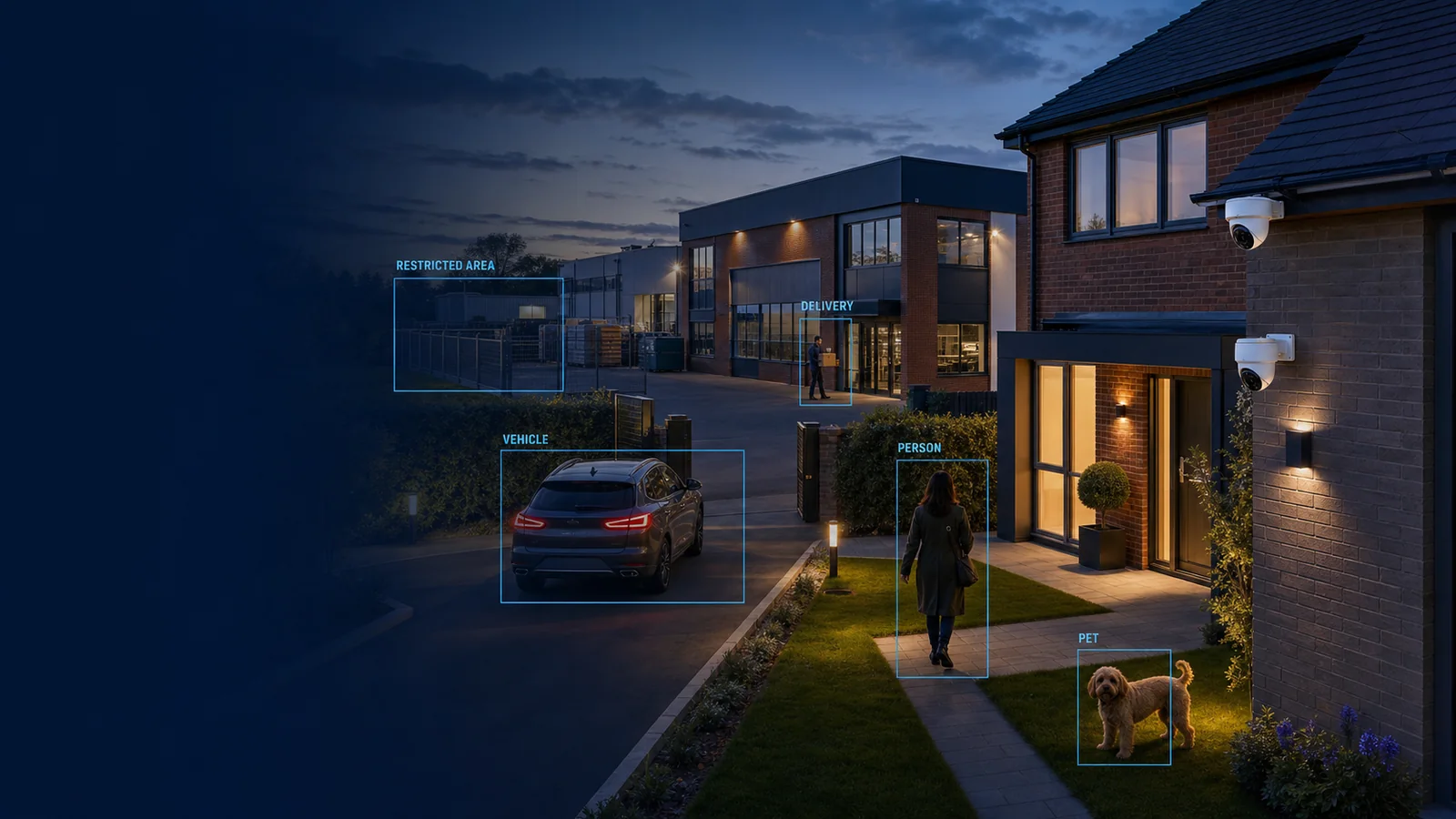
BlueMax designs intelligent CCTV around the events that matter—using human detection, vehicle detection and carefully configured analytics to turn hours of video into useful alerts and searchable evidence.
Relevant alertsClassification configured around genuine risks
Faster reviewFind people and vehicles without scrubbing hours
Useful at nightImaging and analytics planned for real lighting
Human supportSurvey, configuration, training and aftercare
Conventional motion recording can react to almost anything that changes pixels. AI CCTV adds classification and rules so a system can prioritise a person crossing a boundary, a vehicle entering a drive or an object left in a controlled area—while still recording the wider scene.
Human and vehicle classification can reduce interruptions caused by ordinary background movement.
Zones, schedules and event rules help notifications match how a property is actually used.
Filtered playback can surface classified events instead of forcing users to review continuous video.
A clear purpose for every view supports privacy, evidence quality and sensible retention.
Analytics are selected and tuned for angle, distance, lighting, traffic and genuine threat routes.
BlueMax trains authorised users and refines the configuration as seasons or site use change.
Availability and performance vary by product, scene and configuration. BlueMax confirms the required feature in the written system design.
Classifies person-like targets for alerts, playback tags and defined security rules.
Identifies supported vehicle classes at driveways, entrances, yards and loading areas.
Combines class, zone, direction and schedule to make mobile notifications more relevant.
Applies intelligent rules to gates, fences, boundaries and controlled external routes.
Triggers when a selected object crosses a virtual line in an allowed direction.
Identifies a target entering or dwelling within a precisely drawn area.
Filters recorded events by classification to accelerate investigations and exports.
Supports left-behind or removed-object rules on compatible systems and stable scenes.
Provides operational prompts or trends where angle, density and objective are suitable.
Retains colour in suitable low-light conditions to add context to intelligent events.
The right choice depends on the site and outcome. AI is most valuable when conventional motion creates noise or event review consumes time.
| Capability | Normal CCTV | AI CCTV |
|---|---|---|
| Continuous recording | ✓ Available | ✓ Available |
| Basic pixel motion | ✓ Standard | ✓ With intelligent filters |
| Human and vehicle classes | — Usually unavailable | ✓ On supported equipment |
| Nuisance alert reduction | — Sensitivity and zones | ✓ Classification plus rules |
| Event search | — Timeline review | ✓ Filtered by supported classes |
| Line and intrusion rules | — Limited or basic | ✓ Class-aware on compatible models |
| Professional design needed | ✓ Yes | ✓ Essential for reliable analytics |
An intelligent system is especially useful where ordinary movement is frequent but only particular people, vehicles or boundary events require attention.
Separate callers and vehicles from foliage, pets and public-road movement around a property.
Review entrances, stock areas, queues and out-of-hours movement with controlled access.
Protect gates, compounds, loading routes, plant, cages and controlled operational zones.
Prioritise after-hours entrances and perimeter events under clear governance.
Filter movement around remote buildings, machinery, fuel, gates and long approaches.
Support temporary boundaries, restricted areas and investigation of vehicle activity.
These illustrative examples show how BlueMax approaches outcomes. Final equipment, analytics and results depend on a survey and written specification.
Need: useful alerts without notifications from a tree and passing traffic.
Approach: a tighter driveway view, vehicle zone and human line crossing inside the boundary, with road activity excluded.
Outcome: fewer nuisance prompts and faster review of callers and arrivals.
Need: quick review of entrances and rear-door movement after closing.
Approach: human classification, an out-of-hours schedule and role-controlled playback.
Outcome: relevant event markers without continuous manual timeline searching.
Need: distinguish people and vehicles entering a controlled loading area.
Approach: separate directional line rules, overview recording and focused gate coverage.
Outcome: clearer incident chronology and a response prompt matched to operating hours.
Need: protect a remote building where wildlife and weather caused constant motion events.
Approach: human and vehicle filters, stable mounting, refined zones and night-light assessment.
Outcome: a more credible alert channel while continuous local recording remains available.
Need: understand queue pressure without using identity recognition.
Approach: a suitable overhead view and supported queue-duration analytics with a clear operational threshold.
Outcome: a staffing prompt based on flow rather than biometric identification.
Professional AI CCTV begins with purpose and ends with evidence, training and ongoing support.
We identify the events, times, locations and response outcomes that matter.
We inspect routes, subject distance, light, obstructions, network, power and privacy boundaries.
Every proposed view and analytic receives a clear, proportionate purpose.
Models, lenses, analytics, storage, access and exclusions are documented.
Cameras, containment, recorder and network are installed neatly and securely.
Zones, lines, classes, sizes, schedules and notification rules are configured.
We test day and night crossings, playback, alerts, users and evidence export.
Authorised users receive a clear handover, warranty and direct BlueMax support.
These answers explain capabilities and limitations. A BlueMax survey confirms what will work at your property.
AI CCTV uses computer-vision models to analyse video and classify supported objects or behaviours. It can tag a person or vehicle, apply a virtual line or zone rule, filter playback and trigger a configured alert. It remains dependent on a clear image, compatible hardware and careful setup.
Basic motion detection reacts when enough pixels change. AI classification adds an estimate of what caused that change. This can reduce alerts from rain, foliage or shadows when the rule is set to react to a person or vehicle, although no system eliminates every error.
It can. A compatible NVR may record continuously while AI metadata marks important events, or it can use event schedules subject to the security objective and storage plan. Continuous recording provides context before and after an alert and does not rely on the AI recognising every event.
Human classification can reject many animals, and some products offer pet categories. Results depend on the species, size, distance, angle and lighting. A small animal close to a lens or a partly hidden person can still be misclassified, so BlueMax tests the actual scene.
Most person-detection systems classify a human shape without identifying who it is. Facial recognition is a separate biometric process that compares a template with a reference database and brings additional legal, accuracy and governance responsibilities.
There is no simple universal answer. An organisation needs an appropriate lawful basis, and uniquely identifying a person normally involves biometric and potentially special-category data. Necessity, proportionality, transparency, security, accuracy and a data-protection impact assessment may need consideration. Obtain specialist advice for the proposed use.
Human detection is an object-classification feature that estimates whether a target resembles a person. It can be combined with zones, line crossing, schedules, recordings and notifications. It does not confirm identity or intent.
Vehicle detection estimates whether an object belongs to a supported vehicle class. It is useful for driveway, gate, yard and loading-area events. It is not automatically number-plate recognition, and performance depends on an unobstructed, suitably sized view.
No. It can substantially reduce nuisance alerts caused by common scene movement, but glare, obstruction, weather, unusual targets, lens contamination and poor positioning can still create errors. A dependable installation combines classification, good geometry, schedules and periodic review.
Common causes include trees, rain, snow, shadows, cats, birds, headlights, insects, cobwebs, reflections and rapid exposure changes. Basic motion sees image change; it does not understand the reason for the change.
It may happen in the camera, in the NVR or across both. Edge AI can classify events before transmission, while recorder analytics provide central processing and search. Compatibility, channel limits, firmware and feature allocation must be checked for the proposed combination.
A properly configured local camera-and-NVR system can continue recording without an internet connection. Mobile viewing, cloud services and push notifications may be unavailable until connectivity returns. The survey confirms which functions are local and which depend on external services.
It detects a supported object crossing a virtual line, optionally in one direction. It can protect a gate or boundary more precisely than full-frame motion, provided the line is positioned where the camera sees the complete crossing.
Intrusion detection uses a drawn zone and triggers when a supported target enters or remains within it according to configured rules. Despite the name, it cannot know a person’s intention; the zone and response must be designed around a real security purpose.
Perimeter protection combines camera placement, human or vehicle classification and rules such as line crossing or intrusion around fences, gates and controlled routes. It should complement physical security, lighting and a response process rather than replace them.
Some compatible systems can flag an item that remains in a region beyond a chosen time. A stable view, consistent lighting and a clear operational definition are important. Busy scenes, occlusion or routine movement of objects can reduce reliability.
Supported object-removal analytics can monitor whether an expected item disappears from a defined area. They are scene-dependent and should be tested for the specific display, tool, stock location or protected asset rather than assumed from a feature label.
Compatible analytics can estimate queue duration, occupancy or density within a region. Accuracy varies with angle, overlap and site layout. Decide whether the requirement is a prompt, a trend or a formally verified count before choosing equipment.
Smart search uses recorded metadata to filter events by supported classifications or rules. It can reduce investigation time, but the underlying footage should still be reviewed to verify the event before a decision or evidence export.
ColorVu is a low-light imaging technology designed to retain colour in suitable dark scenes through sensitive sensors, wide apertures and image processing. Extremely dark locations may need supplemental light. It is separate from AI classification but can add useful visual detail.
Not without some light. In extremely dark conditions, compatible cameras may use white or hybrid supplemental illumination. Results depend on distance, movement, exposure and the scene, so BlueMax assesses night conditions rather than promising daylight-quality colour everywhere.
No. Resolution is only one factor. Lens choice, target size, angle, lighting, shutter, compression and the AI model all affect results. A correctly positioned camera with an appropriate view can outperform a higher-resolution camera mounted too far away.
Yes, compatible systems can send notifications for configured events. BlueMax limits recipients, zones and schedules so alerts remain useful. Mobile notifications normally require internet access and a supported application account.
Yes. A driveway design can classify people and vehicles, exclude passing traffic and focus on movement within the property. The camera still needs a suitable angle for evidence, and public or neighbouring space should be minimised.
Yes when there is a clear outcome such as out-of-hours entrance alerts, faster event search or fewer yard notifications. A small site does not need every analytic. BlueMax selects the minimum practical system around the business risk and response plan.
Workplace monitoring must be lawful, fair, necessary, proportionate and transparent. Employers should define the purpose, consider less intrusive options, inform workers, control access and avoid using security CCTV for incompatible performance monitoring without proper assessment and advice.
Storage depends mainly on camera count, resolution, frame rate, compression, recording schedule and desired retention. AI metadata itself does not remove the need for storage planning. BlueMax calculates an assumption and confirms it in the quotation.
There is no honest single percentage for every installation. Accuracy changes with the model, scene, target size, lighting, weather and configuration. Important analytics should be commissioned with real-world tests and reviewed after seasonal or operational changes.
No. Human and vehicle classification, face capture, queue analytics, object rules and search functions vary across cameras, recorders, firmware and licences. BlueMax names the equipment and confirmed functions in the written specification.
Check recording, time, views, lenses, alerts, users and night images regularly, and after landscaping, building work or lighting changes. Business-critical systems may need a formal maintenance schedule. Configuration should be refined when legitimate site movement changes.
Possibly. Compatibility depends on the recorder, protocol, firmware, channels, resolution and where the analytics run. BlueMax can audit the existing system and explain whether cameras, recorder or both need upgrading.
BlueMax changes default credentials, configures authorised users, explains secure remote access and avoids unnecessary service exposure. Customers should keep supported firmware, protect mobile devices, remove former users and use individual strong credentials.
Yes. BlueMax is headquartered in Cambridge and installs intelligent home and commercial systems across Cambridgeshire and throughout the UK. See the CCTV installation Cambridge guide for local service information.
BlueMax reviews threats, routes, lighting, distances, network, power, cable paths, privacy boundaries, storage, users and response expectations. You receive a written system design and quotation describing the proposed analytics and their conditions.
Qualifying equipment supplied by BlueMax and BlueMax workmanship are covered by the three-year on-site replacement warranty, subject to the published terms and exclusions. Read the full warranty before booking.
BlueMax Technology Support Ltd combines site-specific advice, genuine compatible equipment, neat workmanship, responsible configuration and long-term support. We explain what an analytic can do, where its limitations lie and how your team or household should use it.
Speak to BlueMax for a site assessment, intelligent camera design, transparent quotation and professional installation.
 WhatsApp
 View Google Business